


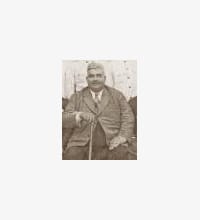
Ângelo Álvares de Freitas
(Santa Cruz, 14/12/1869) - (Santa Cruz, 07/11/1946)
Abstract:
[Santa Cruz, Madeira 14/12/1869 – Santa Cruz, Madeira 07/11/1946]
Founder of the Fraternal and Recreational Society of Santa Cruz, orchestrator, author of notes for music education, music educator, regent of harmonies and composer. Ângelo Álvares de Freitas stood out in the revitalization of the musical life of Santa Cruz and the entire eastern zone of Madeira.
Biography:
Ângelo Álvares de Freitas was born in Santa Cruz in the year of 1869 and died in 1946 in the same county. Son of João Manuel Álvares and Maria Augusta de Freitas, Ângelo Álvares de Freitas was brother of the musician João Manuel Álvares Júnior. He initiated these studies as a child and since younger participated in the regency of harmonies.
In 1886 founded the concerts Fraternal and Recreational Society of Santa Cruz, that according to the publication of the magazine Girão was the first that existed in the locality of Santa Cruz, at least properly organized, with own statutes and written accounting , according to the documentation of January 21st, 1886.
His activity as regent of harmony orchestras was marked passing through the Filarmónica União Fraternal Recreativa Santacruzense from 1893 until 1921, current Banda Municipal de Santa Cruz. In 1895 Ângelo Álvares de Freitas bought an existing building in the block formed by the street from the square (former Coronel street), Point Neuf street, pebble street (today beach street) and street edge from the water, where he kept the seat of the Filarmónica União Fraternal Recreativa Santacruzense until its extinction, in the late 1920s. The seat of the harmony harmony also worked as a musical archive, where the head of orchestra has deposited documents and scores.
Beyond Filarmónica Santacruzense, Ángelo Álvares de Freitas was founder of the Filarmónica D. Carlos I, present Banda Municipal de Machico 1 of November of 1896, where it carried out functions like professor and orchestra conductor.
However, the musical group by which Ângelo de Freitas became recognized was the Filarmónica União Fraternal Recreativa Santacruzense, because of the controversy with António Franco dos Ramos Júnior and Frederico Franco, his brother, both members of the harmony.
At the time, because of the republican factions that settled down in the country, many public institutions underwent infiltrations of the republican political partisans, in order to influence more and more the society. Harmony orchestras were some of the main targets, including Santacruzense. Due to political factors, the Franco brothers “influenced, in part, by the political parties began to take attitudes against the discipline reign in the musical community of which they were a part”.
However, the final fall-out between António Franco dos Ramos Júnior and Ángel Álvares de Freitas took place after a performance of the União Fraternal Recreativa Santacruzense Filarmónica, for the occasion of the takeover of Luís Pereira de Menezes e Agrela, the regenerative part, in Administrator of Santa Cruz County. In this event António Franco dos Ramos Júnior refused to play for political reasons. This attitude has taken the regent to pull the brothers Franco and some more musicians.
In the 31 of October of 1904 the Diário de Notícias published that the Filarmónica União Santacruzense was constituted in two groups: “a governed by Ángelo Álvares de Freitas, to which it is supposed, to remain the original denomination Filarmónica União Fraternal Recreativa Santacruzense” and ” another by António Franco dos Ramos Júnior to what is supposed with the denomination Sociedade Capricho Santacruzense “, which was deduced by a sketch of statutes for this company.
That was the beginning of the “the harmonies of Mr. Angelo and Mr. Franco”, how they were popularly known.
In 1906, in addition to the regency of harmonies, Ángelo Álvares de Freitas was named secretary of the Santa Cruz City Council. A time in which he made many notes for music teaching, such as tunning exercises for bass and clarinet.
The musician remained linked to free music education throughout his life and joined the singing school cantorum, as regent.
A little later, Ramiro Ángelo Álvares, son of Ângelo Álvares de Freitas, held the position of Regent in the Cantorum School, during the 1940s and 1950s.
Because of his talent for orchestration and composition, the musician was much sought after by these friends and colleagues in the musical field to achieve special orchestrations, such as Grande Triunfo Político, produced in 1902 and dedicated to Jayme Rodrigues de Gouveia. These compositions were often dedicated to his friends, simple locations or personalities of public life.
Ângelo de Freitas composed these pieces of music through the flute and left a vast and versatile repertoire that includes sacred music, dance music and sacred and profane vocal works. About the vocal works, the majority with words of its own author, are destined almost entirely to the sacred history, on the life of Santa Amaro, St. Antão and the Virgin Mary. The secular music was intended for the arrival and the departure time of the locations, as Saudação ao Seixal, Romagem a Ponta Delgada and Despedida ao Caniço. In the sacred strand stands the Hymno Nacionalista, composed in 1909 and dedicated to the Portuguese clergy. A composition that was the impression of honors, in the published score.
In the field of instrumental sacred music he composed the following works: Melodia Sacra, Nossa Sr.ª of Lurdes, Soledade da Virgem and Eu Sou Cristão, which could only be interpreted in chapels during religious festivities and thanks to the authorization of the bishop of the diocese.
In the field of dance music, he composed several pieces of dance music for harmonies, to animate the holidays, including: Uma despedida; Jurei nunca but amar, waltz with speech; and Eu Amo-te, waltz with word.
Another musical genre developed was the anthem, dedicated to several personalities, societies, orchestras and occasions, highlighting Hino da Sociedade, Hino Recreativo, Hino da União and Hino do Festeiro.
Ângelo Álvares de Freitas retained contacts in Lisbon and abroad, where he acquired part of this repertoire of performances, improving his musical field.
Authors:
Sousa, Teresa (2011). “Ângelo Álvares de Freitas”. Realizado no âmbito da Disciplina Ciências Musicais VI (3º Ano da Licenciatura em Educação Musical). Funchal: Instituto Superior de Ciências Educativas.
Update:
Ventura, Ana (2011). “FREITAS, Ângelo Álvares de”. In Dicionário Online de Músicos na Madeira. Funchal: Divisão de Investigação e Documentação, Gabinete Coordenador de Educação Artística, atualizado em 01/09/2011.
Music:
Uma despedida; Jurei nunca mais amar (Valsa com letra); Eu Amo-te (Valsa com letra); Hino da Sociedade; Hino Recreativo; Hino da União; Hino do Festeiro; Hymno Nacionalista; Saudação ao Seixal; Romagem a Ponta Delgada; Despedida ao Caniço; Melodia Sacra; Nossa Sr.ª de Lurdes; Soledade da Virgem; Eu Sou Cristão.
Bibliography:
Banda Municipal de Machico (2011). Personalidades. Acedido em 28 de junho de 2011: http://bandammachico.com/index.php?pag=personalidades.
Diário de Notícias (1876 – ). “Coleção de Jornais”. In Biblioteca do Arquivo Regional da Madeira [s.n. recurso digitalizado]. Funchal: publicado em 26/05/1893, p. 2.
Diário de Notícias (1876 – ). “Coleção de Jornais”. In Biblioteca do Arquivo Regional da Madeira [s.n. recurso digitalizado]. Funchal: publicado em 15/08/1895, p. 2.
Esteireiro, P. (2008). “Ângelo Álvares de Freitas”. In 50 Histórias de Músicos na Madeira. Funchal: Associação de Amigos do Gabinete Coordenador de Educação Artística, p. 31-33.
Freitas, M. P. (2007). “Notas [Musicais] Soltas – Contributo para a história da música na Madeira: Concelho de Santa Cruz”. Girão – Revista de Temas Culturais do Concelho de Câmara de Lobos (1º Semestre de 2007, Vol. II, Nº4). Câmara de Lobos: Câmara Municipal, pp. 72-79.
Gabinete Coordenador de Educação Artística (2011). Ângelo Álvares de Freitas. Acedido em 28 de Junho de 2011: http://www.recursosonline.org/index.php?option=com_docman&task=doc_view&gid=1022&tmpl=component&format=raw&Itemid=19.
Morais, M. (coord.) (2008). A Madeira e a Música – Estudos (c.1508-c.1974). Funchal: Empresa Municipal “Funchal 500 Anos”, pp. 463-464.
